You grow when you leave your comfort zone.
Risks come in many sizes, and with varying degrees of impact. Some might be small, and have little impact, such as when debating when to plug in your laptop, when it is nearing the time to recharge it. You balance the hassle of locating a socket, and the relevant cables against if you can finish your current work before you run out of charge. There is not much damage if you run out of charge before you finish. On another occassion, if you run out of charge in your EV, before you arrive at your charging point, you have much larger impact. Similar risk: running out of charge, but different level of impact.
In your own daily tasks, you should notice when, or even if, you take risks. When do you try something new? Maybe it’s to explore a new skill or tool for doing what you do, or try a new food for lunch. It doesn’t matter in some ways.
Each of these will have different impacts if they go wrong. For lunch, you might need to make a new one if it doesn’t work, which is a hassle, but workable. For exploring a new skill, this is the time and effort, or maybe money, if you paid for a workshop. In either case, always start small, with small experiments.
After your experiment, take the time to reflect on what happened. What did it fee like, what was good, what was different from what you expected?
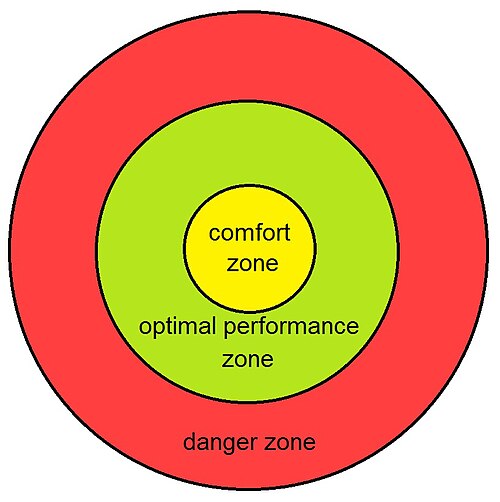
Over time you can use these small experiments to stretch and reshape your comfort zone. You can learn new skills, refresh old ones, and have some surprises, both good and bad, along the way too. Use the experiments to gain different experiences.
If you’re nervous about potential risks, then consider ‘what is the worst that can happen if it goes wrong?’ Be honest about it. You’ll sometimes find this is not as bad as you thought. Yes, it might be embarassing, or slightly painful, but that might be all. The world will not swallow you up. You will survive.
If you think it’s too much, then explore how you might lessen the risk. What would move you forward with the idea, but be less costly, if it goes wrong?
As you do this consider what your assumptions are, as well as the basis for your assumptions. Were these due to past experience, or old memories? Where did you get these from? Now is your chance to update some of your reference points, as you expand your experiences, skills, and other things.
Take your time, talk to people, and slice it smaller. You’ll find a way.
For extra fun, or if you like working with accountability partners, discuss this with a friend, and compare notes about how you’re getting on.
This post is part of a project pulling together my materials and ideas about Teaching Team Collaboration: the Human-Side of Software Development for software development to students.
If you’d like to be notified of future posts, then please sign up for more using the adjacent form. When you sign up, then I’ll send you a free copy of the collaboration rules as a PDF from the book. You can also follow me on LinkedIn
The ideas above are from my book 101+ Ideas to Improve Team Collaboration, which covers all of these little things that students can do to improve their collaboration. Also available via Kindle.