Practice, practise, and praxis are all important parts of learning.
Learning new skills and knowledge is often slow. That’s ok. Read a bit, think a bit, apply the bit.
Be slow. Apply what you learn in small steps. Learn as you go. There is no rush.
I discovered the other week another UK/US difference in English. I’d always used practice both as the thing, the noun, and as the verb, or the doing. This is the version I’ve encountered in books, and other references. However, it seems that in the UK the verb is spelled with ‘s’ instead of ‘c’. In UK practice is the noun, and the thing, while practise is the verb, or the doing of the thing.
Then there is praxis, which is the practical application of the theory in the doing. This is the word I often end up using, as I think it sounds nicer.
Oh, well. Interesting, but not life-changing.
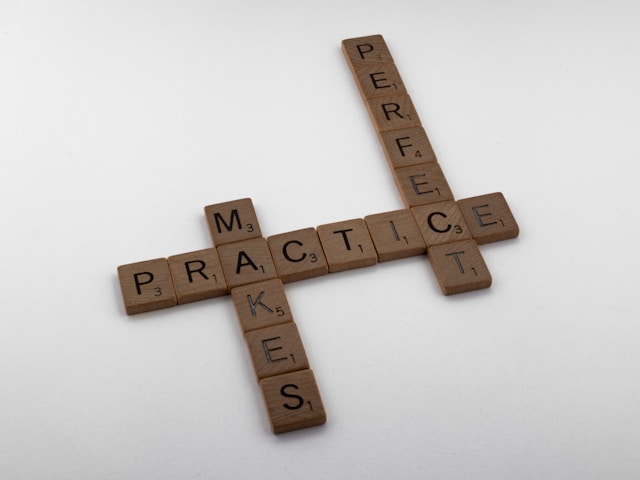
Learning mostly arrives when you apply theory as praxis
It raises a key point about learning. You need to move past the absorbing phase of reading, or watching videos about something, and use what you’re studying in practice. Learning isn’t enough. You need to apply the knowledge to make it useful.
Often only by applying what you’re learning do you gain insight into the nuances of the material, and the tools.
This is why all the best workshops and facilitation sessions offer participants the opportunity to apply what was covered. Without that opportunity to apply the new knowledge, it is just words that aren’t solidified by practice.
While writing this I was once again fighting with the various expo and react native libraries, and tools used to upgrade and validate an installation. This time around I learned more about the tools, and some of the nuances around semver notation in package.json files. No, it’s not exciting, but it is useful to know every now and then if you’re developing nodejs applications.
It seems that I often learn the most when it’s the most frustrating. This is not the fun I thought I was signing up for, but it seems to be when I learn more than planned.
I might think “I’ll update the libraries as it’s been a month.” What really happens is that I see a new error as something is more out of date than expected, and I need to do more updates. Then to confirm it all works correctly, I remove the node_modules directory and reinstall all the libraries. Node has other ideas and finds dependency conflicts. Look those up, and find more insight… rebuild … find error … repeat from install … find error … almost there… add notes to readme files and make a commit to save the work … try again the next day… success … make new commit
This is my work these days. Two steps forward, one step back. Inching my way forward slowly as I read, try something, learn something.
Discuss your process with your people. Compare note to see how they do their learning and applying what they read.
This post is part of a project pulling together my materials and ideas about Teaching Team Collaboration: the Human-Side of Software Development for software development to students.
If you’d like to be notified of future posts, then please sign up for more using the adjacent form. When you sign up, then I’ll send you a free copy of the collaboration rules as a PDF from the book. You can also follow me on LinkedIn
The ideas above are from my book 101+ Ideas to Improve Team Collaboration, which covers all of these little things that students can do to improve their collaboration. Also available via Kindle.