Show others how you apply what you’ve learned.
You should practice and develop your collaboration skills by taking part in hackathons, startup bootcamps, co-design events, and similar activities. None of them contribute directly to a final degree, but do provide opportunities for you to practice the skills you’re learning in the classroom and elsewhere.
These events provide lots of opportunities for you. You practice your skills, you learn new skills, and you widen your network of people too. You will meet the organisers, possible mentors, and have moments to possibly talk to potential employers too.
If meeting new people frightens you a bit, then convince a friend to go with you. You both have a buddy, and a safe bubble too. I know this can be important for some people. It is a good thing for both of you to spread your wings a little bit, and to learn new things too.
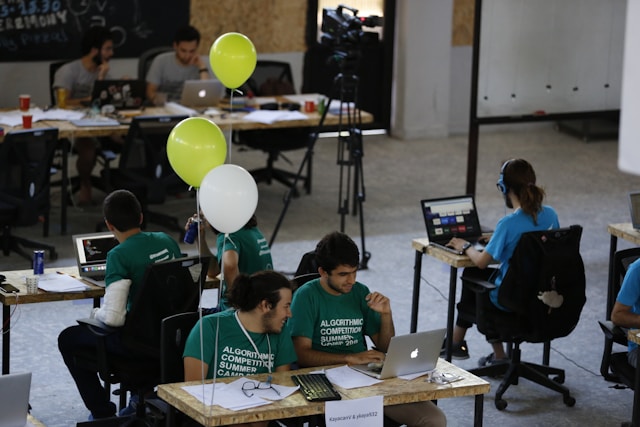
Hackathons offer many benefits
Hackathons are a good way for people to learn by doing, which combines fun and novelty with opportunities to apply what you learn too. These are the same qualities that make good training sessions work too.
I’ve helped organise small hack events where people spent time together working on their own projects, and pausing to provide updates during the day, as well as week-long ones that started locally and then gathered for the national event too. They all work best when you follow a few simple guidelines:
- Set a theme, or guide to aid people’s thoughts and ideas.
- Provides mentors and volunteers to guide people on how to do the things they need to do such as connect to the wifi, or organise an activity.
- If suitable, provide stakeholders, who can guide the teams with feedback on their proposed ideas.
- Find sponsorship to cover some of the costs, or make the pricing clear up front for the event.
- Encourage sustainable practices too.
You’ll notice there is no mention of prizes. They are not the draw people think they might be. Nor is free food. Focus on providing an exciting experience, and you’ll do well.
The last one is an aspect I find discouraging: the 24 or 48 hour event with no break for people to sleep. For me, those events encourage unsustainable practices. You wouldn’t want to work for a company that expects you to work long hours, and do overtime all the time. Events I and colleagues have run, always told people to go home, eat, sleep, and return for breakfast. People need their break, and sleep. They think better, and are more creative too with sustainable practices.
For those looking to participate in hackathons, then go look at these sites. You will find they also cover details about hosting an event too. Most offer both in-person and virtual online events.
Major League Hacking focuses on student events. Devpost and Hackathon seem to cover students, corporations, and public events. All of them seem to provide a range of events.
Hackathons UK is what it says for UK student hackathons. The site seems quiet.
All of the above are general hackathons focusing on computing and sometimes other subjects too. You can also look for more specific areas too.
The main one is perhaps the Global Game Jam, which creates a global event. This elevates it to a different level if you know that other groups are gathered around the world working on games following the same theme. This also illustrates that you want designers, and other people at your hackathon too: not just people to code.
Ludum Dare is the other place to take part in game development events too. While the event is online, you take part in your team, or solo project. There are also different themes, or types of events too.
If you’re in Scotland, and aim to get into game development, then follow Scottish Games Network. This site posts about upcoming game development hackathons, and other relevant events for those who are interested in one of Scotland’s largest economic areas.
The global game jam inspired the Global Service Jam, which focuses on service design: creating services for people. This no happens a few times each year with a general focus, one for those in government delivering services, and a third on sustainability. Each of them guides people in creating prototypes of the solutions, so people learn skills they can take back to their day-job. Every time I’ve taken part in one of these, I’m amazed by what people create, and how far they go afterwards with the skills they learn.
Similarly there are also startup weekend events for people to meet and explore ideas for possible businesses too. I’m not sure how successful these are as a way to start a business, but are good for exposing people to some of the ideas you need to think about as you start one.
A business can also do an internal hackathon, or development event too. These are often done as ‘FedEx Days‘ where the teams focus on a theme, or area and see what can ‘be delivered’ in a day.
Encourage your people to take part in hackathons
Have your team, or students attend hackathons. Maybe even find people willing to organise one too. They gain lots of fun, and experience as attendees. Running one offers different opportunities, and adds facilitation and organisational skills too. You’ll find the notes I wrote up about organising hackathons when I did it with Code the City.
Before you organise one, go to at least one yourself if possible. It helps clarify lots of issues, and widens your experience too. Remember, if you’re nervous, bring a friend.
This post is part of a project pulling together my materials and ideas about Teaching Team Collaboration: the Human-Side of Software Development for software development to students.
If you’d like to be notified of future posts, then please sign up for more using the adjacent form. When you sign up, then I’ll send you a free copy of the collaboration rules as a PDF from the book. You can also follow me on LinkedIn
The ideas above are from my book 101+ Ideas to Improve Team Collaboration, which covers all of these little things that students can do to improve their collaboration. Also available via Kindle.