My time is up at the charity.
I left Code the City, Aberdeen’s coding for good charity that focuses on using open data. I was a founder and trustee from June 2014 until a few weeks ago. Now it will be different. Other people will carry it forward. You can also see our work in the Code the City GitHub repos.
Code the City was needed as a way for the four of us to regularly carry forward activities. Ian Watt, Steve Milne, Andrew Sage and myself were regularly organising and hosting events again and again in Aberdeen from around 2010 onwards. Setting up a trust, which later became a charity, meant it was easier to fund hack and co-design events; we could carry over funds from one event to the next.
We ran 32 hack events as CTC, plus another 5 or more before hand. We also took part in the Global Day of Code Retreat a number of times, as well as the Global Service Jam. We also set up Scottish Open Data Unconference too, which kicked off Open Data Scotland, an open data portal.
The most memorable event was probably our archeology hack event in 2018 when we had teams trying different aspects to plot burial plots into a digital space. We had 600 year old skeletons to prototype scanning options, to see if/how this might be done with mobile devices, as well as exploring how to move data from the layer data from dig diagrams to a 3D virtual reality of the dig space. Then on the Monday I was back in the same room for teaching as normal.
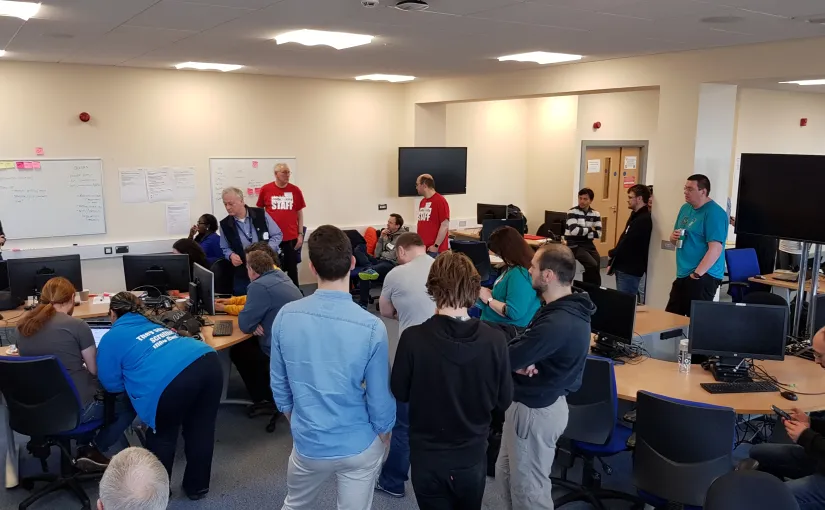
CTC created opportunities for students
Running Code the City meant I could always tell students about events that were relevant to their studies. We provided opportunities for them to apply what we were teaching them. Opportunities for them to gain experience that could be added to their CVs.
When we added monthly meet-ups we also offered talks and short workshops too. It was good to see students and others grow in their experience and abilities over the years.
I found that I could move ideas back and forth from CTC events and my the classrooms. An idea for facilitation could be tried in one place and then used in the other. It meant not having to wait too long for another occasion to refine my practice of a technique.
Mostly, however, it was good to see students applying what they learned in our sessions. You could watch them grow, and gain confidence. It was great to be a part of their journey.
Join or create your own coding for good organisation
Help your people by pointing them to your local coding for good organisations. This is where they can explore new ideas, and gain experience. They can also meet people, who might help them in their careers too.
You also get to meet lots of people in your city too. You have more reasons now to talk to people, and also find people who could be speakers in your classrooms too. You also never know who you’ll meet, who could help you in your career.
This post is part of a project pulling together my materials and ideas about Teaching Team Collaboration: the Human-Side of Software Development for software development to students.
If you’d like to be notified of future posts, then please sign up for more using the adjacent form. When you sign up, then I’ll send you a free copy of the collaboration rules as a PDF from the book. You can also follow me on LinkedIn
The ideas above are from my book 101+ Ideas to Improve Team Collaboration, which covers all of these little things that students can do to improve their collaboration. Also available via Kindle.